

Informing on music news in the world
Provided by AGP
‘America Is Human’: Boris Grebenshchikov on New York, the American Dream, and the True Purpose of Rock Music
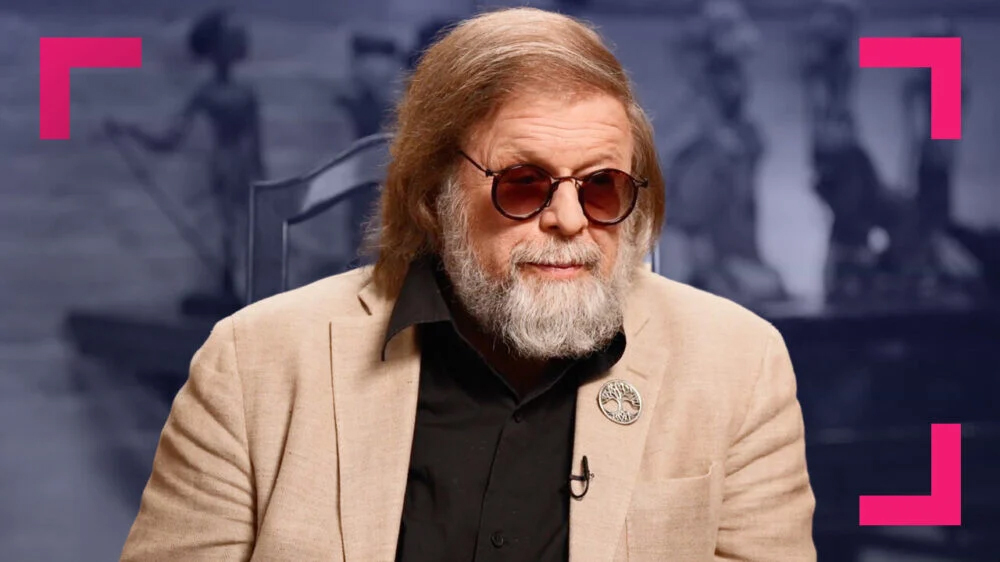
Boris Grebenshchikov

RTVI US
RTVI US, the leading Russian-language media outlet in the United States, has released an exclusive interview with Boris Grebenshchikov.
I learned very firmly in those 18 months that if I wake up thinking about where to find money, there's no point in even hoping for that day. <...> Nothing will come of it.”
NEW YORK, NY, UNITED STATES, May 18, 2026 /EINPresswire.com/ -- RTVI US, the leading Russian-language media outlet in the United States, has released an exclusive interview with Boris Grebenshchikov, the founder and frontman of the legendary rock band Aquarium and a figure widely regarded as one of the founding fathers of Russian rock music. In a wide-ranging conversation, Grebenshchikov reflects on his first arrival in New York in 1987, his enduring love for the American Dream in its simplest form, his close encounters with David Bowie, Lou Reed, and George Harrison, and the true purpose of rock music — which, he argues, has nothing to do with protest.— Boris Grebenshchikov
Grebenshchikov first arrived in New York in December 1987 to work on Radio Silence, his English-language debut released by CBS/Columbia and produced by Eurythmics co-founder Dave Stewart. Nearly four decades later, he says the city — and the country — have not changed in any way that matters.
"I fly in from London to New York, drive from JFK, arrive in Manhattan, and there are these construction sites, these little shacks. And suddenly I understand that this is the beautiful value of it — that New York, like all of America, is human," Grebenshchikov tells RTVI US. "The value of the United States is that it's a country built by simple people who don't care for fancy tricks. Everything should be simple."
For Grebenshchikov, the American Dream has likewise remained intact: "You walk into any restaurant, any café, and they bring you a dish — one big enough that it's enough. That's the dream of a normal person — a simple person, no fancy tricks, just enough to eat. That's the American Dream. And I fully embrace it."
The reality of those early years in New York, however, was anything but easy. Arriving from the Soviet Union, Grebenshchikov and his wife lived on roughly $80 a week. "We had to come up with something every single day — where to find the money to eat that morning. I learned very firmly in those eighteen months that if I wake up thinking about where to find money, there's no point in even hoping for that day. There's no point picking up the guitar. Nothing will come of it. I've killed myself."
The struggle was worth it. Beyond the album and a memorable appearance on Late Night with David Letterman, those years gave Grebenshchikov something far more lasting — friendships with the artists whose music had shaped him. "I was lucky to spend real time with David Bowie, with Lou Reed, not to mention Dave Stewart and that whole circle, with George Harrison, with a great many people on whose music I grew up. And it turned out that the way they are in music is exactly the way they are in life. It's simply a miracle. It's a gift from God."
Asked about a song that captures the spirit of New York then and now, Grebenshchikov points to Lou Reed's Perfect Day, written more than fifty years ago about a date in Central Park. The song, he says, describes the atmosphere of New York just as accurately today as it did when it was written.
But on the question that has shadowed Russian rock for decades — whether the genre is, by nature, a music of protest — Grebenshchikov pushes back sharply, attributing the idea to the influential Russian music critic Artemy Troitsky.
"That's something Artemy Troitsky came up with. Nonsense," Grebenshchikov says. "Forgive me, but what was Elvis Presley or Jerry Lee Lewis protesting against? God forbid he was protesting anything. He had no time for that. There were more important matters. Protest changes nothing."
Though Aquarium's influence on generations of Russian-speaking musicians is enormous, Grebenshchikov refuses to position himself within any official narrative of rock history. "I will never be able to take that seriously," he tells RTVI US. "I have no idea what I was doing. I remember it, theoretically — but what matters to me is what I'm doing now. I live in tonight — between today and tomorrow."
For Grebenshchikov, the purpose of a musician is not to lead, but to free. "I can't influence people in any real way. All we can do is give a person the chance to feel that freedom exists — the freedom to feel, to think, to walk, to speak, to perceive. Each of us is, in truth, a great perceiver, a great witness. All we can do is give a person the chance to think for themselves — not to instill in them what they should think, but to give them the space to think and feel on their own. That is the highest gift we can offer. If even a single note in one of my songs moves a person to throw off the clichés and start thinking and feeling for themselves, then I consider my task fulfilled."
There was one moment, however, when he felt rock music could exert real-world power — at the famed Leningrad Rock Club in the late 1980s, where unauthorized concerts often ended in police arrests of audience members.
"I was incredibly lucky, because at the end of the 1980s I had the chance to walk onto the stage of the Rock Club and say: 'There will be no concert until you return the people you took to the station.' And when all the guardians of the law realized there were maybe twenty of them and three hundred of us in the hall — they returned them. I'm grateful I got to touch that feeling, when you understand that maybe not everything is arranged justly, but there are moments when everything seems to turn in the right direction. It never truly turns. But when it seems to be turning — that's a wonderful feeling."
As for his own prescription against gloom? "Listen to something cheerful," Grebenshchikov advises — recommending System of a Down or Black Sabbath.
The full interview is available exclusively on RTVI US's YouTube channel.
Overseas Media Inc dba RTVI US
Overseas Media Inc dba RTVI US
vzapadnia@rtvi.us
Visit us on social media:
YouTube
Instagram
Facebook
LinkedIn
X
Other
Exclusive interview with Boris Grebenshchikov
Legal Disclaimer:
EIN Presswire provides this news content "as is" without warranty of any kind. We do not accept any responsibility or liability for the accuracy, content, images, videos, licenses, completeness, legality, or reliability of the information contained in this article. If you have any complaints or copyright issues related to this article, kindly contact the author above.
